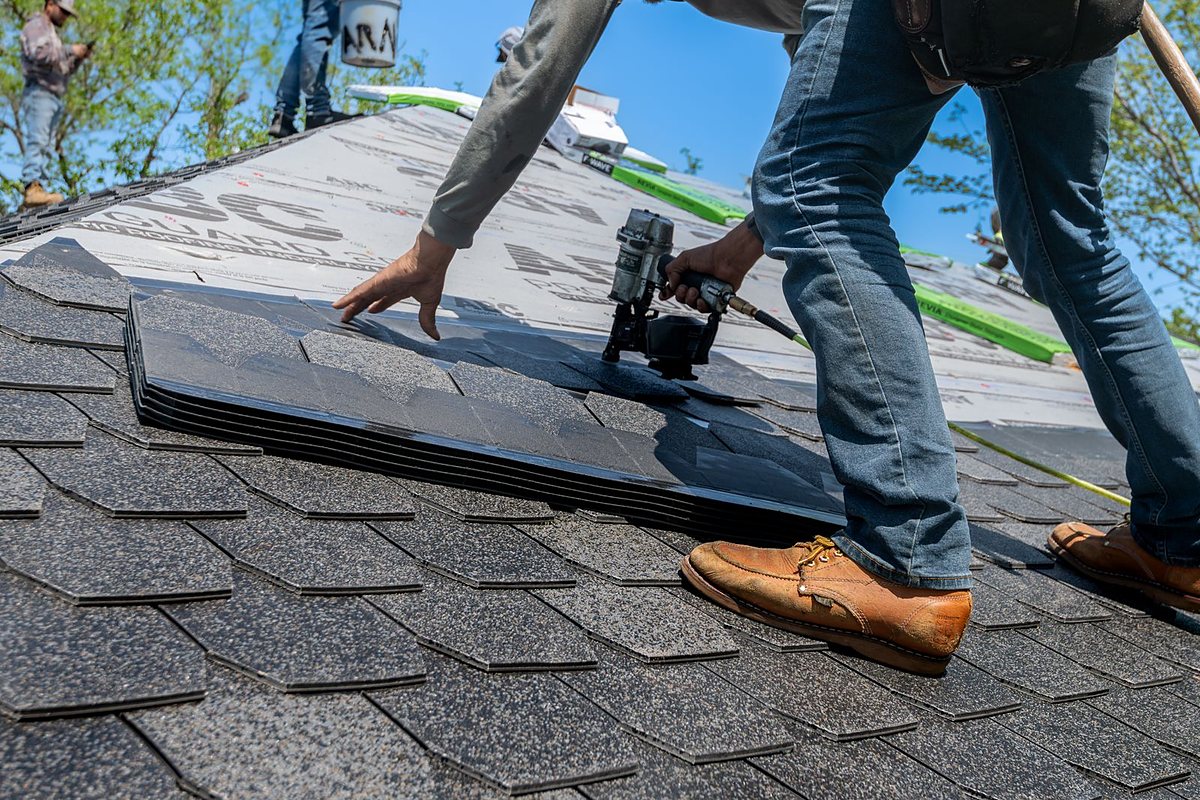
What we repair
Most roofing repairs fall into a handful of categories. Knowing which one you are dealing with explains the price and the urgency:
- Flashing failures at walls, chimneys, skylights and where a porch or addition meets the main roof. These are the most common source of leaks that reappear after every storm.
- Pipe boots and vent seals — the rubber collar around plumbing vents cracks after years of UV, and water runs down the pipe into the ceiling.
- Wind-damaged shingles: lifted, creased or missing tabs, often along ridges, hips and edges where wind pressure is highest.
- Valley wear, where two roof planes meet and live oak debris holds moisture against the surface.
- Nail pops and fastener back-out, which tear the shingle from underneath and create slow leaks.
- Fascia and soffit rot from clogged gutters and splash-back, which is a carpentry repair as much as a roofing one.
- Storm openings from limbs, hail impacts or wind-borne debris.
When a repair is the right call — and when it is not
A repair makes sense when the roof is structurally sound, the problem is localized, and the rest of the shingle field has useful life left. A repair is usually the wrong call when:
- The shingles are already curling or losing granules across multiple slopes.
- Leaks are appearing in unrelated parts of the roof within a short period.
- The decking is soft or the roof has been patched repeatedly.
- The roof is at or beyond the age your insurer will cover at replacement cost.
We would rather fix a $600 problem than sell a $14,000 roof. But we will also tell you when a repair is throwing money at a roof that is already finished — and explain why, with photos.
Not sure if that leak is a repair or a replacement?Call and describe what you are seeing — we will give you a straight answer before anyone climbs up.
Call (352) 614-6215How we find the actual leak
Water is lazy and dishonest. It enters at one point, travels along the deck or a rafter, and shows up somewhere else entirely. A stain on the ceiling near a hallway wall might originate ten feet away at a vent boot.
We start with the symptom and work backward: the location and timing of the stain, whether it appears only during wind-driven rain, and what is directly uphill from it. On the roof we check the penetrations, flashings, valleys and terminations in that path. In the attic, where access is safe, we look for water tracks on the decking and rafters, daylight, and damp insulation.
Only then do we quote the repair. Patching the visible symptom without finding the entry point is how a small leak becomes a recurring one.
Wind and storm damage repairs
After a summer storm or hurricane band moves through, the damage is not always obvious from the ground. Wind can lift and crease shingles without tearing them off, break the seal on ridge caps, and drive rain sideways into flashing that was never designed for that angle.
We inspect after storms, document what we find with dated photos, and separate wind damage from age-related wear — a distinction that matters to your adjuster. Temporary tarping is available when water is actively entering, with permanent repairs scheduled once conditions allow.
If you are filing a claim, read our guide to storm damage roof repair and insurance documentation before you call the insurer.
What roof repairs cost in Gainesville
Typical repair ranges we see in Alachua County:
- Pipe boot or vent seal replacement: $250–$550.
- Small flashing repair at a wall or chimney: $400–$900.
- Valley repair or section replacement: $650–$1,800.
- Wind damage to a slope, including matching shingles: $500–$2,000.
- Fascia and soffit repair: $450–$2,500, depending on length and rot.
Matching existing shingles is not always possible on older roofs; we will show you the closest available match and explain how it will look before we start.
Ready to get a real answer?Call (352) 614-6215 and describe what your roof is doing. Written estimates across Gainesville and Alachua County.
Call (352) 614-6215Questions & answers
Frequently asked questions
Straight answers about roof repair in Gainesville.
Can you repair a roof in the rain?
We can stop active water intrusion with temporary tarping or sealant during rain, but permanent repairs need dry conditions for the materials to bond properly. Call while it is raining — we will advise on temporary protection and schedule the permanent repair.
My ceiling stain is small. Can I just paint over it?
No. The stain is the visible end of a water path that is still active or recently active. Painting it hides the evidence and lets the moisture keep working on insulation, drywall and framing. Find and fix the entry point first, then repair and repaint the ceiling.
Will a repair void my roof warranty?
Not if it is done correctly with compatible materials. Poor repairs, incompatible sealants or work by an unlicensed party can void coverage. We document the repair and use materials compatible with the existing system.
How quickly can you get out for a repair?
Active leaks and storm openings are prioritized, usually same day or next morning. Non-urgent repairs are typically scheduled within a few business days. Call (352) 614-6215 and we will give you a realistic window rather than a vague promise.
Do you repair roofs you did not install?
Yes. Most of our repair work is on roofs installed by someone else. We will inspect it, tell you what failed and whether the failure looks like installation error, material defect or age.
Is it worth repairing a 20-year-old shingle roof?
Sometimes, if the repair is small and the rest of the roof is holding. But at 20 years in North Central Florida, most shingle roofs are near the end of their service life, and a large repair may not be the best use of money. We will show you the evidence and let you decide.
Your Gainesville roofing company serves homeowners across Alachua County and North Central Florida.